







The Screen and the Stone: An American Influencer’s Misadventure in Paris
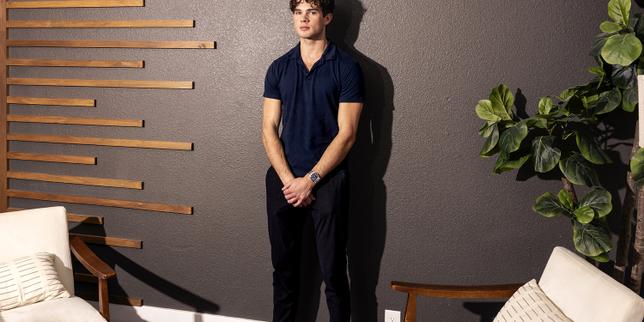
On a damp Tuesday afternoon near the Saint-Michel fountain, a young woman carrying a string bag of books paused just long enough to look at the tripod. The man behind it, an American influencer known to his followers as Clavicular, flashed a practiced, symmetrical smile. He spoke in the rapid, high-friction cadence of the internet, offering a compliment that sounded less like admiration and more like a challenge. The woman did not frown, nor did she argue; she simply adjusted her scarf, stepped around his field of vision, and dissolved into the afternoon crowd.
This quiet refusal, captured in high-definition and broadcast to thousands of viewers, has become a recurring spectacle. For months, this avatar of the modern online men's movement has wandered the historic avenues of Paris, attempting to translate digital dominance into physical romance. What he has encountered instead is a stubborn, analog wall of indifference.
The project of the online masculinist is built on the premise that human interaction is a system to be optimized. On platforms like TikTok and YouTube, these creators speak of social dynamics in the language of programmers. They treat conversation as a series of inputs designed to yield predictable outputs.
Yet, when these theories are dragged out of the comment sections and onto the pavement of a real city, the code breaks down. Paris, with its ancient geometry and deeply ingrained codes of public reserve, has become the ultimate testing ground for this failure. The street does not have an algorithm, and its inhabitants do not feel compelled to engage.
The Illusion of the Predictable Interface
In the digital spaces where Clavicular built his brand, attention is the only currency that matters. Aggression, certainty, and a performative disdain for modern social norms are rewarded by platforms designed to maximize engagement. In those spaces, a creator does not need to persuade; they only need to provoke.
When this style of interaction is brought to the physical world, it reveals its inherent fragility. The camera, which serves as a shield for the creator, becomes a warning sign for the pedestrian. To those walking the streets, the lens is not a window to a community, but an intrusion.
"The mistake they make is believing that because they have conquered an audience, they have conquered human nature," says Marianne Lemaire, a sociologist who studies digital behavior in urban spaces. "They arrive in a physical space expecting the crowd to behave like their comment section."
Instead, the streets offer no moderation tools, no block buttons, and no sympathetic filters. The influencer is left with only his script, which sounds increasingly hollow when spoken aloud in the open air. The silent walks away from his camera are not just rejections of him, but of the very medium he represents.
The Screen as a Filter of Reality
There is a particular cruelty to the live-streamed format that these creators favor. In a recorded video, failure can be edited out, leaving only the polished successes and the carefully curated triumphs. Live broadcasts, however, are unmerciful mirrors that show every hesitation, every awkward silence, and every polite dismissal.
As the American roams from the Marais to Belleville, his chat feed scrolls by at a dizzying pace. Some viewers offer advice, others mock his posture, while many simply revel in the discomfort of the exchange. The spectacle is no longer about the art of attraction, but about the slow, public dissolution of an ego.
The internet has spent a decade training young men to believe that confidence is a mathematical equation. They watch videos of creators who seem to move through the world with a golden glow of absolute certainty. But this confidence is a product of the edit, a fiction constructed in the quiet of a laptop screen.
This tension reveals the deep irony at the heart of the modern influencer economy. To maintain their status, these figures must constantly seek more extreme environments to prove their theories. They must take their digital logic into places where it is entirely unwelcome, turning their own lives into a public experiment.
When the Algorithm Meets the Boulevard
To walk through Paris is to participate in an unspoken contract of mutual observation and mutual privacy. It is a city where looking is an art form, but staring is an offense. The American's approach, characterized by its loud directness and disregard for these subtle boundaries, violates this contract.
On these streets, the silence of a Parisian rejection is not loud, but it is absolute. There is no negotiation, no dramatic confrontation that can be clipped for social media. The target of the camera simply continues their walk, their silence leaving the creator to stand alone with his microphone.
This clash is not merely cultural, but deeply technological. The influencer is trying to impose the flat, transactional logic of the internet onto a space built on centuries of physical negotiation. He believes that with the right sequence of words, the lock must turn.
But the passersby do not share this belief. They are not users; they are citizens with offices to reach, groceries to buy, and lives that do not require validation from an American smartphone. Their indifference is not a political statement, but a natural defense against the commodification of their daily lives.
As the sun begins to set over the Seine, casting long shadows across the stone arches, the screen glows a little brighter in the dusk. The young man prepares another opening line, his thumb hovering over the broadcast button, waiting for the digital applause that never quite reaches the street. The camera stays warm, but the city remains cold, beautiful, and entirely out of reach.
Chat PDF avec l'IA — Posez des questions a vos documents