







The Friction Premium: Why Gen Z is Swiping Left on Apps and Right on Ancient Liturgy
In the late nineteenth century, as industrialization pulled millions of young workers from rural farms into crowded cities, the YMCA pioneered a new kind of urban infrastructure. It was not merely a gym; it was a physical network designed to anchor disoriented youth in a rapidly changing world. Today, we are seeing a similar migration, though this time the migration is digital rather than geographic.
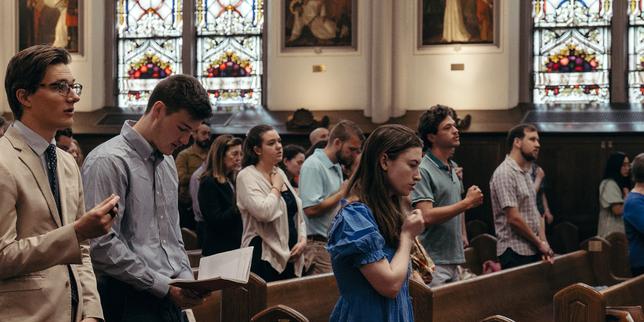
Young people, exhausted by the relentless demands of self-curation on social platforms, are seeking shelter in the oldest institutions they can find. The Catholic Church in the United States, despite being a minority faith in a highly secularized culture, is experiencing an unexpected influx of Gen Z adherents. In metropolitan areas like Washington, D.C., parishes are finding that the key to attracting this cohort lies in combining ancient liturgical structure with hyper-local social networks.
The Premium of High-Friction Communities
Why are twenty-somethings filling church pews on Sunday morning and attending parish-sponsored speed-dating events on Wednesday night? The explanation lies in what economists call the "friction premium." For the past two decades, technology companies have focused on removing friction from every human interaction, from buying groceries to finding a partner.
This frictionless existence has created a paradox: when connection requires zero effort, it holds zero value. Young professionals who spend their days building ephemeral software are craving physical structures that have resisted change for centuries. In a world of fluid identities, an unyielding institution becomes an anchor rather than a cage.
By hosting casual social gatherings like happy hours alongside traditional worship, these religious communities are effectively redesigning their customer acquisition funnel. They are meeting young adults where they are, offering a low-stakes entry point into a high-commitment ecosystem.
The Shift from Algorithmic Matching to Shared Frameworks
Dating apps promised to maximize romantic choice through sophisticated sorting algorithms, yet they have left a generation feeling deeply isolated. The church-basement speed-dating event succeeds precisely because it rejects the premise of the endless scroll. It replaces the infinite pool of potential partners with a self-selecting group of people who already share a baseline set of values and commitments.
This is a design principle that modern software developers understand well: opinionated frameworks save cognitive energy. Just as a programmer chooses a specific coding framework to avoid writing basic architecture from scratch, these young adults are adopting ancient traditions as a social operating system. They are outsourcing the exhausting work of inventing their own moral codes and social norms to a system that has been debugged over two thousand years.
"The modern search for community is no longer about digital convenience; it is about finding high-density, analog networks that demand something real from their participants."
The Return of the Physical Third Place
Sociologist Ray Oldenburg long ago identified the "third place"—the social surroundings separate from the two primary environments of home and the workplace—as crucial for civil society. As commercial third places like coffee shops have become transaction-oriented and expensive, churches are stepping into the void. They are offering free, un-monetized space where people can gather without the pressure of consumerism.
This trend points to a broader cultural correction that will define the next decade of human organization. The assumption that everything would eventually migrate to the cloud was incorrect; the cloud was merely the staging ground for a deep hunger for physical presence. The organizations that thrive in the coming years will not be those that offer the most advanced digital interfaces, but those that design the most meaningful offline gatherings.
Five years from now, the defining social trend will not be the expansion of the metaverse, but the deliberate retreat into physical sanctuaries, proving that the ultimate disruptive technology is simply being present in the same room.
Createur de films IA — Script, voix et musique par l'IA