







The Architecture of Late-Stage Identity: Lucy Sante and the Geometry of Truth
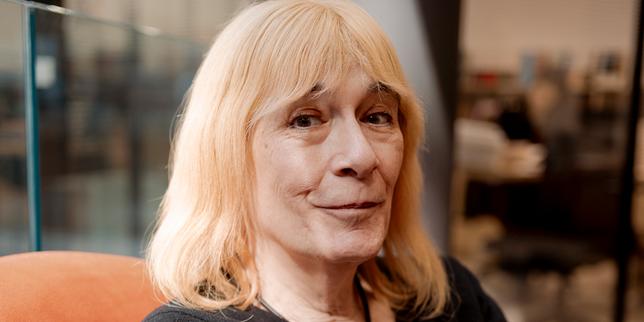
The Preservation Strategy of the Human Spirit
In the mid-19th century, the great European cities underwent a process of 'Haussmannization,' where the old, tangled medieval streets were cleared to make way for wide boulevards. This was not just urban planning; it was a physical manifestation of a new way of being. We often view our personal histories through a similar lens of reconstruction, yet we rarely permit ourselves the radical renovation that writer Lucy Sante has recently undertaken. After decades spent documenting the underbelly of New York City alongside peers like Jean-Michel Basquiat and Jim Jarmusch, Sante has released her most intimate archaeology yet: the dismantling of a false internal structure.
Identity is frequently treated as a fixed deposit, something established in youth and guarded until the end. However, Sante’s transition in her late sixties suggests that the self is more akin to a biological record, a set of strata that can be re-examined and re-sorted even after the ink has seemingly dried. Her new book, I Heard Her Call My Name (published in French as D’elle à moi), functions as an audit of a life lived in a necessary but exhausting secrecy. It reframes the concept of late-life change not as a rupture, but as a final alignment of the internal compass.
The most expensive tax a human pays is the energy required to maintain a facade that contradicts their internal physics.
For decades, Sante was the preeminent voice of the 'low' history of Manhattan—the tenements, the crime scenes, and the forgotten corners. It is striking that a writer so obsessed with uncovering the truth of a city was simultaneously suppressing the most fundamental truth of her own existence. This irony highlights a profound psychological mechanism: we often become masters of external observation precisely because the internal view is too painful to behold.
The Digital Mirror and the Velocity of Change
The acceleration of Sante’s transition was facilitated by a tool as modern as her history is deep: a simple smartphone filter. This serves as a vital reminder that technology does not merely provide distractions; it provides mirrors. For an individual who had survived by burying their reflection in the grit of 1970s punk culture, seeing a digitally rendered possibility of her true self acted as a catalyst. It bypassed the intellectual defenses she had spent sixty years constructing.
This shift represents a broader movement in how we understand the lifecycle of the professional and the personal. The industrial age dictated a linear path: growth, stability, and then a slow fading into the background. In the current era, the boundaries between these stages have dissolved. Sante's choice to transition during her emeritus years challenges the cultural assumption that the 'self' is a finished product by the time one reaches middle age. She proves that the capacity for profound structural change is not a luxury of the young, but a latent power available at any coordinates on the timeline.
Working within the artistic circles of the East Village during its most fertile period, Sante witnessed the birth of postmodernism—a movement defined by the idea that everything is a construct. Applying this logic to one's own gender is the ultimate act of creative agency. By stepping out of the shadows of denial, she has transitioned from being a witness of New York’s history to being the architect of her own final act.
From Documentation to Embodiment
There is a specific kind of liberation found in the late-stage shedding of layers. When Sante discusses her transition, she does not speak in the language of loss, but in the vocabulary of arrival. The 'painful questioning' that defined her earlier decades has been replaced by a clarity that can only be achieved when one stops fighting their own gravity. This is the economics of the soul: once the overhead of performance is removed, the remaining energy is free to be invested in genuine presence.
We are entering an epoch where the 'legacy' of an individual is no longer just their body of work, but the integrity of their evolution. Sante’s transition is a lighthouse for an aging population that has been told for generations that it is too late to change. Her story suggests that the longest journey we take is the few inches from who we are expected to be to who we actually are. The bravery lies not in the change itself, but in the willingness to let the old version of the self die so that the truth can survive.
In five years, we will look back at this cultural moment and realize that the most significant technological and social shift was not the digitization of our systems, but the permission we gave ourselves to rewrite our own narratives at any age.
Createur de films IA — Script, voix et musique par l'IA