The Quiet Geometry of a Prague Morning
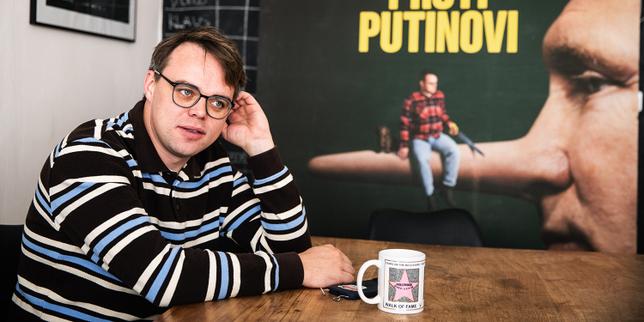
Pavel Talankin sat in a sparse café on the banks of the Vltava, his thumbs tracing the worn edge of a ceramic mug. The golden statuette that recently bore his name was thousands of miles away, safely tucked into a shelf, yet its presence felt like a heavy anchor in the room. He spoke of the light in the Urals, not as a cinematographer, but as a man who remembered the specific, dusty amber of a classroom at dusk. It was in that room he captured the footage for Mr. Nobody vs. Putin, a film that would eventually strip him of his ability to return home.
For Talankin, the transition from observer to subject happened with a sudden, clinical coldness. One morning he was a chronicler of his country's internal mechanisms; the next, he was officially designated an agent of the state's enemies. The label arrived via a digital notification, a piece of bureaucratic prose that effectively erased his citizenship while he was still brushing his teeth in a foreign city. It is a peculiar modern tragedy to be unmade by the very institution you sought to document with such care.
The film itself does not rely on grand gestures or sweeping political speeches. Instead, it focuses on the minute, rhythmic indoctrination of children in an Ural schoolhouse. Talankin watched through his viewfinder as teachers, perhaps well-meaning in their own minds, wove war into the curriculum like a new color in a familiar pattern. He saw the way the children bent their heads over desks, accepting a reality that was being constructed for them in real-time. It was this intimacy, this refusal to look away from the small scale, that made the work so dangerous to those in power.
The Cost of the External Gaze
To the Kremlin, Talankin represents a specific kind of betrayal: the insider who refuses to keep the family secrets. By filming the hearts and minds of the next generation, he moved past the geopolitical noise and touched something far more sensitive. The state responded not with a critique of his craft, but with a systematic dismantling of his identity. In the eyes of the law in Moscow, he is no longer a creator; he is a foreign operative, a ghost haunting the borders of a nation that has closed its doors to him.
I did not want to make a political statement; I simply wanted to see if the children still looked like children when they were told they were soldiers.
Exile provides a strange clarity, but it also creates a profound silence. Talankin finds himself in Prague, a city defined by its own histories of resistance and occupation, yet he remains an outsider among outsiders. He walks the cobblestones and wonders if the textures of his homeland will eventually fade from his sensory memory. The fame brought by the Academy Award feels thin, a layer of gold leaf over a foundation of grief. He is celebrated by the world, but the one place he truly knows has declared his vision a crime.
The threats are no longer abstract. They arrive in his inbox and echo through the rhetoric of state-controlled broadcasts back home. There is a concerted effort to discredit his history, to paint his career as a long-gestating plot funded by distant interests. This is the new reality for the documentarian: the camera is no longer a shield. In the digital age, the distance between a director and his subject can be closed in an instant by a state that views truth as a variable rather than a constant.
Reflections in a Distant River
Talankin often thinks about the students he left behind in that schoolhouse. He wonders if any of them will ever see his film, or if he will remain a name whispered in warning by their instructors. The tragedy of his situation is not just the loss of a career path or the physical danger of return. It is the realization that the people he filmed are being taught to view him as a stranger. He has become the very 'Mr. Nobody' of his title, a figure defined by his absence and his dissent.
The machinery of propaganda is efficient because it targets the quietest parts of a person. It replaces local memory with national myth, and Talankin’s lens was an attempt to catch that replacement in the act. Now, in the relative safety of the Czech Republic, he continues to work, though the subjects have shifted. He is learning to film the feeling of waiting, of watching a world from the other side of a glass wall. The lens is still clear, but the view has changed forever.
As the sun dipped below the spires of the city, Talankin adjusted his coat and stepped out into the street. He looked at the faces passing by, people living lives untouched by the specific weight of a state's displeasure. He is a man who knows the secret cost of a perfect shot. He walked toward the bridge, a filmmaker without a country, wondering if the next generation would ever find a way to look back through the lens he left behind.