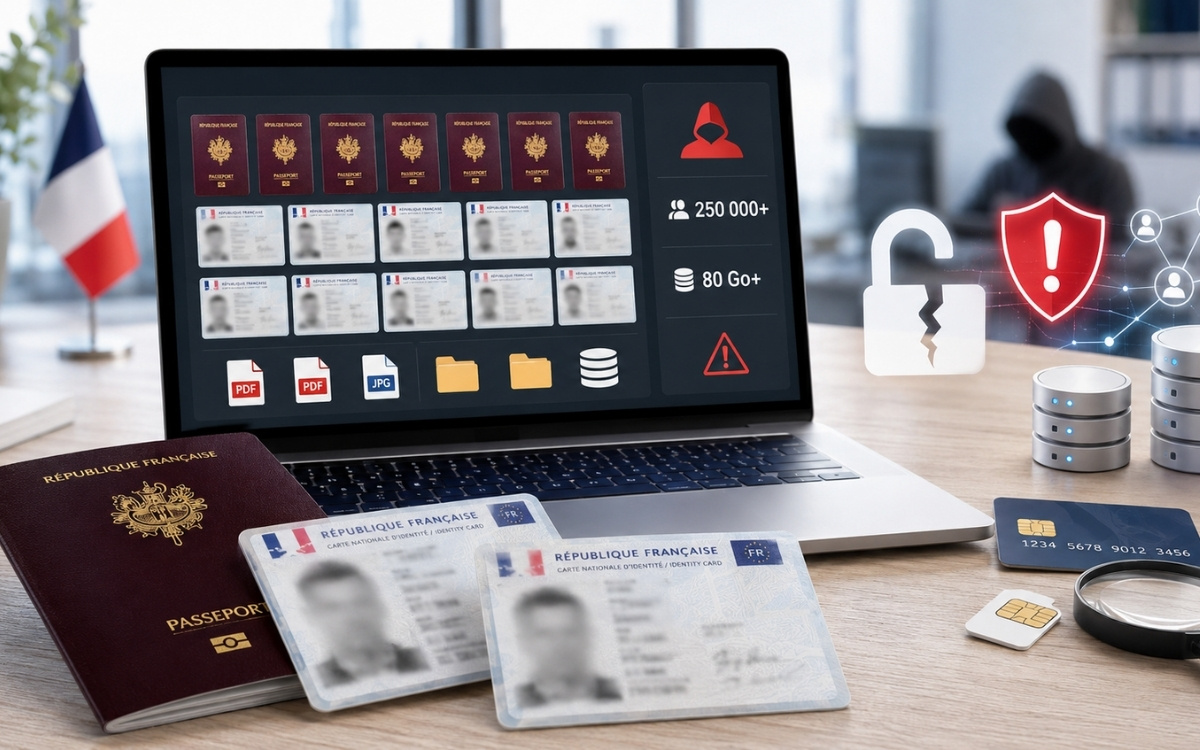
Marc, a high school history teacher in Dijon, spent three hours last Tuesday looking at a low-resolution scan of his own face on a computer screen. The photograph was from his 2018 national identity card, the one he thought he had lost during a rainy weekend in Brittany. But here it was, glowing in the dim light of his study, offered as a sample in an online ledger.
The ledger belongs to an anonymous seller known only as ChimeraZ. For the price of a modest dinner in Paris, anyone with a basic understanding of encrypted networks can purchase bundles of these digital relics. More than eighty thousand unique files, containing a estimated quarter-million French passports and national identity cards, have been put up for sale in this single digital marketplace.
This is not a story about a complex bank heist or a sophisticated breach of state secrets. It is about how easily the physical proof of our existence is peeled away from us, leaving behind digital ghosts that wander the dark corners of the internet. We have traded the heavy tangibility of paper for the frictionless world of the scan, and in doing so, we have lost control over how we prove we exist.
The Scrap Value of Citizenship
In France, the carte d’identité is more than a plastic card. It is a symbol of republican belonging, a physical manifestation of one's relationship with the state. Yet, in the hands of brokers like ChimeraZ, these sacred documents are reduced to mere files, sorted by region, file size, and image clarity.
Each scan represents a moment of mundane administration. A car rental in Bordeaux, a hotel registration in Nice, or a proof-of-age check for an online purchase. These paper trails, once forgotten in physical filing cabinets, now accumulate forever in poorly secured corporate databases.
"We gave our faces to these systems because we were promised convenience, but we forgot that a digital copy is permanent," Marc told me. "My physical card expired years ago, but my digital self is apparently immortal."
The trade in these documents operates with a quiet, corporate efficiency. There are no dramatic negotiations, only digital shopping carts and automated payment portals. For the buyer, these cards are raw material for financial schemes; for the seller, they are simply digital assets left unprotected by negligent custodians.
The Vulnerability of Being Known
The danger of these leaks is rarely immediate. It is a slow, creeping vulnerability, a feeling that your biography is no longer entirely your own. A stolen passport scan can be used to open a bank account, sign a lease, or register a business on the other side of the world without your knowledge.
In our current environment, we have been forced to treat our physical attributes as passwords. We upload our faces to verify our identities, forgetting that unlike a password, a face cannot be changed. Once a high-resolution scan of your passport is public, that proof of life is permanently compromised.
The French administration prides itself on the elegance of its bureaucracy. Yet this centralized elegance makes the system fragile. When a single security gate fails, the state's guarantee of identity collapses into a cheap commodity.
The Weight of the Paperless State
We are living through a strange transition where the physical world is treated as an optional interface for the digital one. We no longer carry paper because we trust corporate databases to remember who we are. But these databases have a terrible memory, retaining everything we wish they would forget while losing the keys to our privacy.
There is a profound loneliness in seeing your own identity document presented as a retail item. It reduces the entire weight of a human life—the years lived, the borders crossed, the citizenship claimed—to a few kilobytes of metadata. It suggests that our digital existence has become more real, and more vulnerable, than our physical presence.
As Marc closed his browser that night, he looked at his physical wallet sitting on the wooden desk. The worn leather felt solid, heavy, and reassuringly real. But he knew that somewhere in a server rack he would never see, his digital double was still waiting to be sold.