




The Data of Decay: Why Environmental Documentation is the Next High-Value Asset
The Monetization of Ecological Scarcity
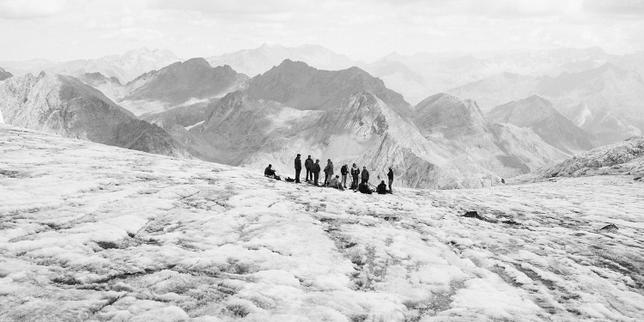
This is not an art project. It is a forensic audit of a planet’s balance sheet. When Grégoire Eloy follows glaciologists through the Pyrenees or marine biologists along the coast of Brittany, he is documenting the rapid depreciation of natural capital. For a decade, Eloy has embedded himself with scientific teams to capture what can only be described as a forced liquidation of ecosystems.
From a strategic perspective, these black-and-white images serve as high-fidelity data points in an era where Environmental, Social, and Governance (ESG) metrics are often criticized for being opaque. Eloy’s work at the Villa Pérochon in Niort removes the corporate gloss from climate change. He focuses on the physical reality of the supply chain of life: the receding ice and the invasive species disrupting local maritime economies.
The Scientific GTM: Credibility as a Moat
The competitive advantage of Eloy’s methodology lies in his distribution and access. By aligning his output with peer-reviewed research, he bridges the gap between raw data and public perception. This is a classic B2B2C model where the scientist provides the technical validation, the photographer provides the interface, and the public consumes the narrative.
- Verification over Aesthetics: Every frame is tied to a specific scientific mission, making the work harder to dismiss as mere commentary.
- Long-term Alpha: A ten-year archive of specific geographic shifts creates a proprietary dataset that grows in value as the original sites disappear.
- Operational Transparency: By documenting the scientists themselves, he highlights the labor-intensive process of truth-seeking in a post-truth market.
The proliferation of exotic species in Finistère is not just a biological quirk; it is a signal of a market disruption in the local fishing and tourism sectors. Eloy captures the friction between the native environment and these new, aggressive entrants. It is a visual representation of a hostile takeover occurring at the microscopic and macroscopic levels simultaneously.
The Asset of Radical Observation
In the tech world, we talk about observability as a mission-critical function for maintaining complex systems. Eloy is applying this principle to the biosphere. His work functions as a monitoring layer for a system that is currently throwing off thousands of error codes. The strange, shifting forms in his photography are the visual equivalents of system latency and resource exhaustion.
The photographer does not just look; he records the friction between what was promised by the environment and what is being delivered.
Investors and founders should look at this work as a precursor to the Climate Tech boom. Before you can build the solution, you must accurately map the failure. Eloy’s ten-year head start on this documentation gives him a unique position in the market of environmental awareness. He is not selling a product; he is selling the clarity required to understand the total addressable problem.
I am betting on the companies and creators who treat climate data as a hard asset rather than a marketing expense. The real winners will be those who can translate these visual signals into actionable risk models. If you are ignoring the physical decay documented by Eloy, you are mispricing your long-term risk.
AI Film Maker — Script, voice & music by AI