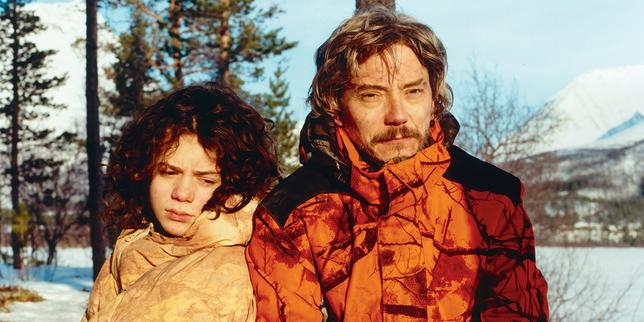
The Illusion of the Polar Frontier
Most movie marketing is a predictable assembly line of glossy stills and staged authenticity. We are conditioned to see behind-the-scenes photography as a secondary artifact, a mere footnote to the moving image. Yet, Vincent Desailly’s documentation of the Sukkwan Island set in northern Norway suggests something far more aggressive. He isn't just capturing a film being made; he is documenting the friction between a fictional narrative and an environment that is indifferent to human storytelling.
The adaptation of David Vann’s novel requires a specific kind of bleakness that many directors try to manufacture in post-production. By embedding himself in the Arctic Circle, Desailly captures the moments where the actors stop performing and the environment begins to impose itself. The value here isn't in the celebrity of the cast, but in the erosion of the boundary between a character’s isolation and a photographer's observation.
When the Set Becomes the Subject
Cinematic framing usually seeks to hide the seams of production. Desailly does the opposite, leaning into the artifice to reveal a deeper truth about the medium. His shots of reconstructed interiors placed against the sprawling, desolate Norwegian backdrop highlight the absurdity of the creative process. It is a visual dialogue about how we attempt to colonize harsh reality with scripted emotions.
Ses clichés, au cadrage très cinématographique, interrogent la frontière entre la fiction et le réel.
This observation gets to the heart of why these images matter more than a standard trailer. In a digital age where every frame is polished to a plastic sheen, Desailly uses a cinematic eye to validate the physical struggle of the shoot. The lens doesn't just record the scene; it interrogates the cost of recreating Vann’s dark psychological territory in a place that actually wants to kill you.
The Narrative of the Unseen
We often talk about immersion in tech and media as if it’s a feature to be toggled. These photographs prove that true immersion is a physical consequence of geography. When you look at his compositions, you aren't seeing a set decorator's triumph; you are seeing the survival of an aesthetic. The lighting isn't merely functional; it is a character that dictates how much of the truth we are allowed to see at any given moment.
Digital marketers and creators should pay attention to this shift in visual storytelling. We are moving away from the era of the 'perfect' shot and toward an era of documented authenticity. Desailly isn't selling a movie; he is selling the atmosphere of its creation, which is often more compelling than the final cut itself. This approach respects the intelligence of the audience, acknowledging that we know it's a fiction while forcing us to confront the reality of its construction.
Whether Sukkwan Island succeeds as a film remains to be seen when it hits theaters in late April. However, the photographic record already stands as a definitive argument for the importance of the physical location. In an industry increasingly obsessed with virtual stages and synthetic environments, these frames remind us that there is no substitute for the raw, unscripted hostility of the North.