You're Not Always Stuck Because You're Lazy. Sometimes You're Stuck Because You Want It to Be Perfect.
There’s a kind of delay that looks very respectable.
It doesn’t look like laziness.
It doesn’t even look like procrastination.
In fact, it looks like hard work.
You sit down at your desk.
You focus.
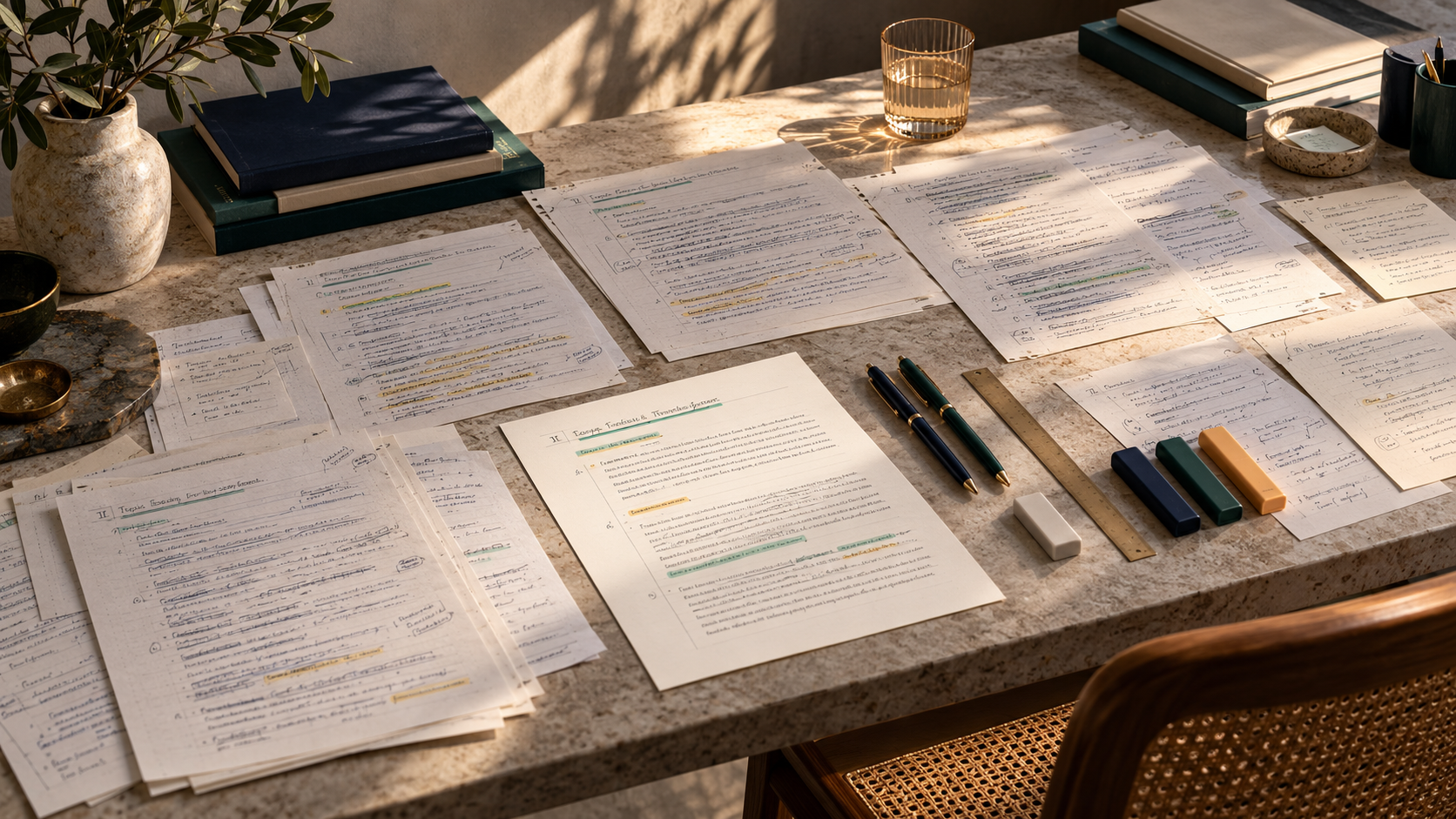
You rewrite a sentence.
You redo your revision sheet.
You restart an introduction.
You tell yourself you need to understand everything perfectly before moving on.
Meanwhile, the evening disappears.
And the real problem stays hidden:
you may be afraid of doing something imperfect.
Perfectionism often looks like seriousness
That’s why it’s so difficult to notice.
If you spend forty minutes on one paragraph, nobody immediately assumes you’re wasting time.
You look focused.
You look disciplined.
But ask yourself one question:
Is this extra time actually improving the work, or is it only making you feel safer?
There’s a difference between improving something and endlessly retouching it.
Between fixing an important mistake and rearranging the same heading three times.
Between learning from an exercise and refusing to leave it until it feels flawless.
While you keep polishing one detail, your other priorities remain untouched.
What perfectionism really steals from you
It doesn’t only steal time.
It steals momentum.
When every task has to be excellent, starting becomes harder.
Finishing becomes harder too.
You hesitate more.
You correct yourself too early.
You get exhausted trying to produce something exceptional when something solid would already have been useful.
And by the end of the day, you may feel something frustrating:
“I worked for hours. Why did I finish so little?”
Because the problem wasn’t effort.
It was the standard your brain demanded before allowing you to move on.
Try the “good enough first” method
Next time you study or prepare an assignment, separate the work into two phases.
Phase 1: produce a useful version.
Not a perfect one. Just something clear, correct, and workable.
Phase 2: improve it if necessary.
That might mean:
- making a simple revision sheet before trying to make it beautiful;
- writing a complete answer before trying to make it brilliant;
- finishing three exercises before trying to perfect one;
- building a plan before polishing the introduction for half an hour.
This method doesn’t lower your standards.
It simply protects your energy.
Progress first, polish second
That’s also the mindset behind Glamzn’s Study Mode.
It can help structure a study session around a concrete objective, instead of letting you get trapped in one endless detail.
The goal isn’t careless work.
It’s learning to produce, check, and improve in the right order.
Today, choose one task you tend to overwork.
Give yourself twenty minutes to create a version that is simply useful.
You may discover that making progress helps you more than trying to satisfy your own impossible standards.