Your Exam Won't Look Like Your Textbook. Are You Ready for That?
There's an uncomfortable difference between studying a chapter and seeing what an examiner can actually ask you to do with it.
In your textbook, everything has its place.
Chapter one introduces the concepts. Chapter two explains the methods. Practice questions appear right after the explanations they relate to.
You usually know what you're supposed to use.
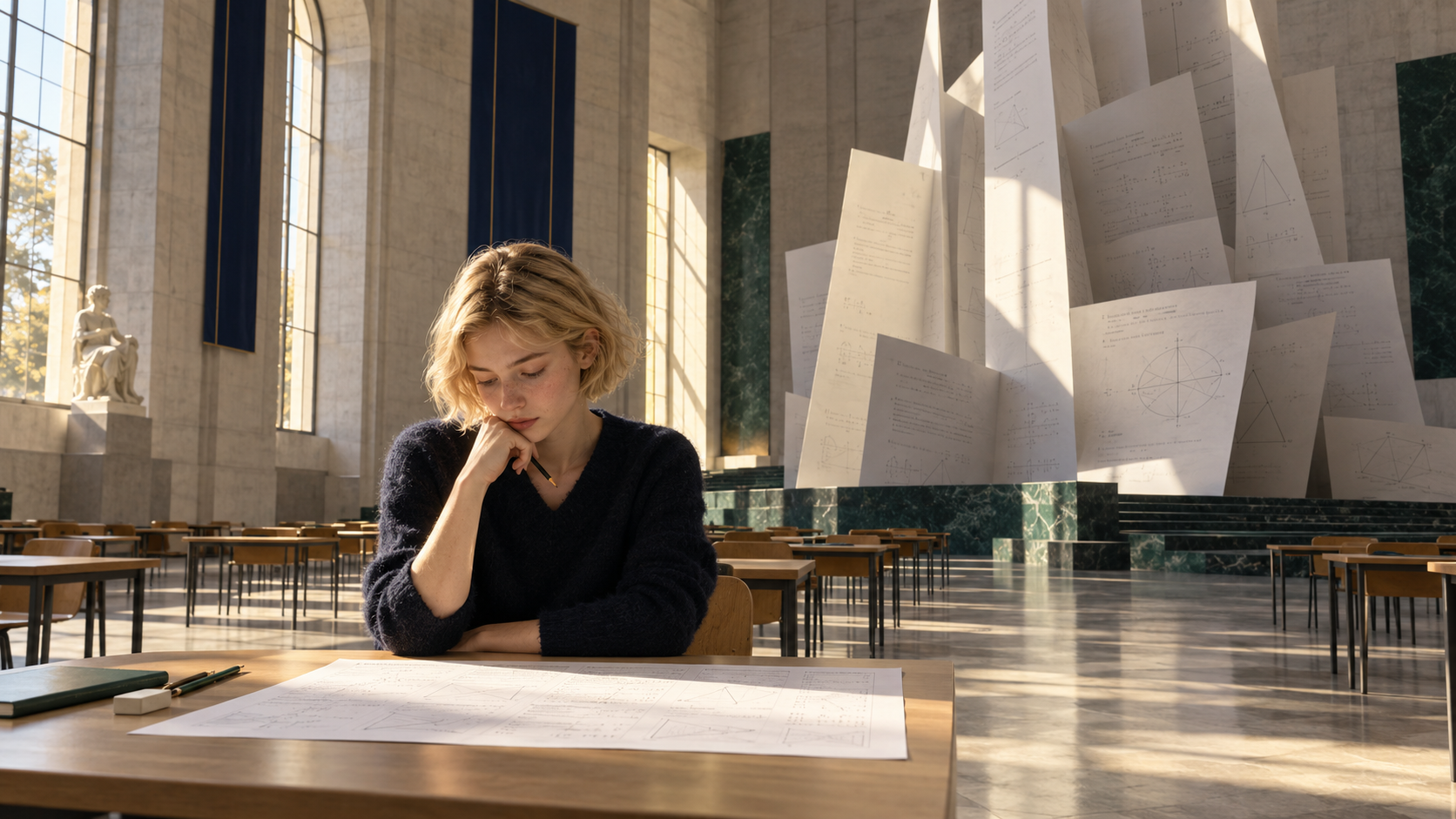
Then you open a past exam paper.
Three documents to analyze. A question connecting different topics. Instructions you have to read four times.
And suddenly:
“But I've studied all of this…”
Maybe you have.
The question is whether you've practiced deciding when and how to use what you know.
Exams don't always follow your textbook's structure
This is one of the problems with predictable revision.
When you finish a chapter about probability, you already know the next exercises will probably involve probability.
When you revise a particular historical period, you know which events and arguments are relevant.
An exam may not give you those clues.
It might ask you to choose the correct method, combine knowledge from different chapters, or interpret an unfamiliar instruction.
You're not just being tested on what you remember.
You're being tested on what you can do with it.
That's why finishing your revision doesn't automatically mean you're ready for the exam.
Why saving past papers until the end can backfire
Many students treat past exam papers as a final test.
They wait until they've covered the entire syllabus before opening one.
It seems logical.
After all, who wants to attempt an exam they aren't ready for?
But past papers aren't only for measuring performance.
They also help you recognize question formats, understand expectations, and practice choosing an approach.
If you only discover those challenges the night before your exam, you've lost opportunities to work on them.
Try the open-paper method
Here's a different way to use your next past paper.
Find one that matches your course and exam level.
Don't immediately start answering.
Spend ten minutes examining three things.
What knowledge does this require? Identify the topics, formulas, or concepts involved.
What is the question really asking? Notice the difference between explaining, comparing, calculating, evaluating, and proving.
Where would you begin? Write down the first steps you'd take.
Only then should you attempt a question without looking at the solution.
You don't need to complete the entire paper.
Start with one problem.
The goal is to become familiar with real exam demands while there's still time to improve.
Give yourself a preview of the real challenge
Through Glamzn's educational library, you can look for revision resources, including past exam papers and practice exercises, depending on what's available for your course.
Choose a relevant paper, attempt a question, and identify the knowledge you need to revisit.
Explore study resources on Glamzn
This week, open a past paper before you feel completely ready.
The best time to discover what you can't do yet is while you still have time to learn how.