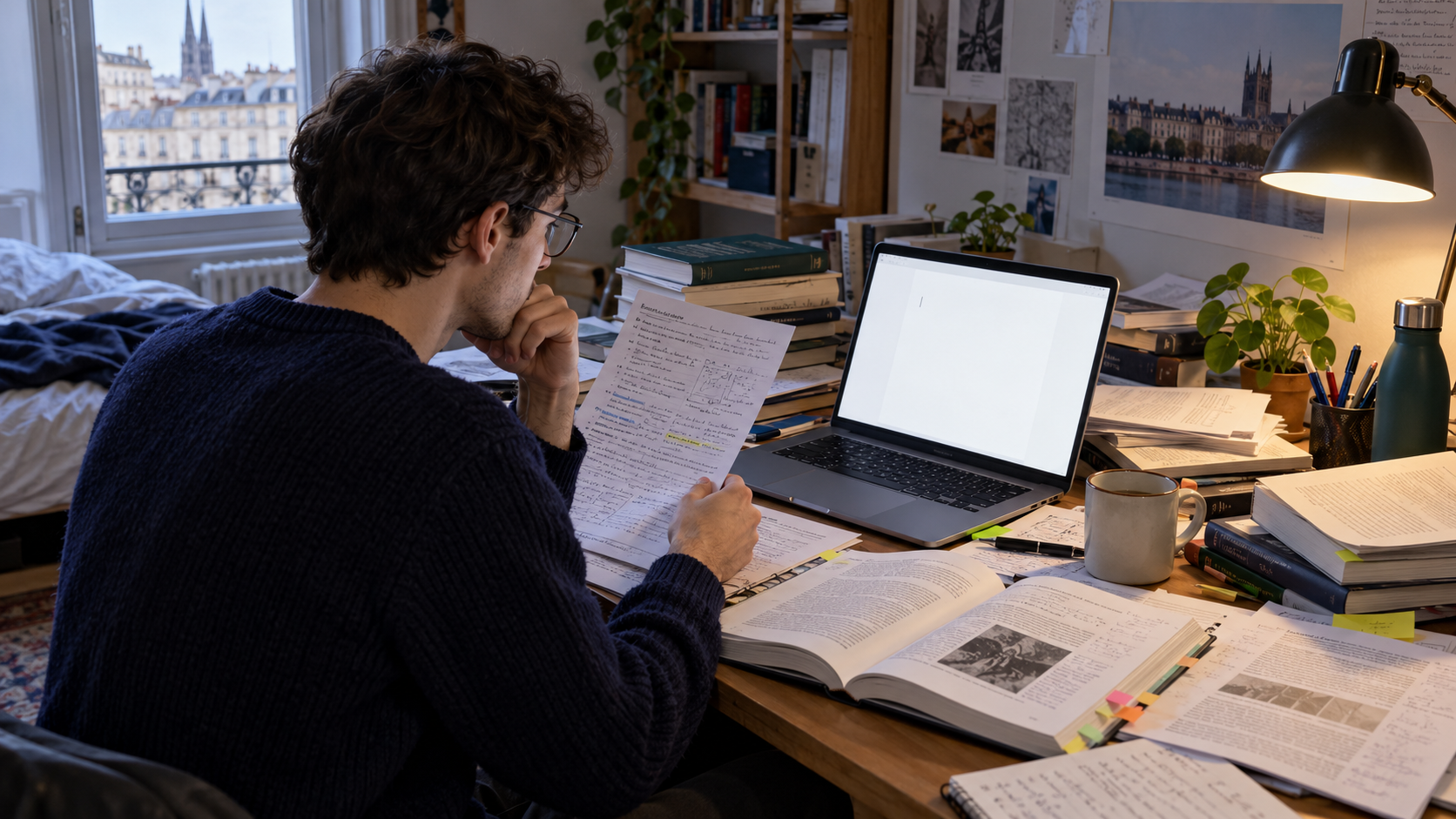
You've Downloaded 30 Research Papers. Your Thesis Is Still Blank.
Your research folder looks impressive.
It's packed with journal articles, reports, studies, and a few PDFs you barely remember downloading.
You've opened dozens of browser tabs. You recognize several important authors. You've even collected quotations that might work beautifully in your introduction.
There's just one problem.
Your actual document is almost empty.
So you search for another paper.
Then another.
You promise yourself you'll start writing once you've gathered enough information.
But what if researching has become a way to avoid writing?
The trap of one more article
Research is an essential part of academic writing.
But it can also become a comfortable hiding place.
As long as you're searching, you're doing something that feels useful without committing to an argument.
Writing is different.
You have to decide which ideas matter, which sources belong together, what evidence supports your position, and what you actually want to say.
Those decisions can be intimidating.
Especially when you're worried about missing an important article.
So you keep reading, hoping you'll eventually feel completely prepared.
The problem?
In academic research, there's almost always something else you could read.
Every source should have a purpose
Imagine your thesis examines how social media influences purchasing decisions.
You discover a fifteen-page article about consumer behavior.
It looks relevant.
But before reading everything, ask yourself:
"Which question in my research could this article help answer?"
If it discusses trust in influencers, it might support a section about credibility.
If it studies a completely unrelated audience, it may be less useful to your particular argument.
This doesn't mean ignoring important evidence.
It means reading with a clear purpose.
A source becomes more valuable when you understand what role it can play.
Try the one-source, one-idea method
During your next session, select three relevant sources.
For each one, write four short notes.
Main argument: What is the author actually saying?
Supporting evidence: Which finding, example, or method matters most?
Relevance: Does the source support, challenge, define, or complicate an idea in your research?
Placement: Where might this information belong in your outline?
Keep accurate citation details and page numbers too.
You now have more than a collection of downloaded documents.
You have material you can use to build an argument.
Start writing before your research feels complete
Next, choose one subsection from your outline.
Write a paragraph using information you've checked in your sources.
It doesn't need to be brilliant.
You can revise it, expand it, or even remove it later.
But you've started doing the work that turns research into academic writing.
Not simply gathering knowledge.
Organizing evidence into your own reasoning.
Your research materials should support your thinking
With Glamzn's Chat with Course, you can explore compatible materials you've uploaded and ask questions about concepts you find difficult.
It's a useful way to revisit explanations or examine distinctions in your documents.
But always verify important information against the original source. Accurate citations and your final analysis remain your responsibility.
Explore your materials with Glamzn
Today, close a few tabs.
Choose three sources.
Then write one paragraph.
Your thesis won't move forward just because your reading list gets longer. It moves forward when you start doing something meaningful with what you've read.