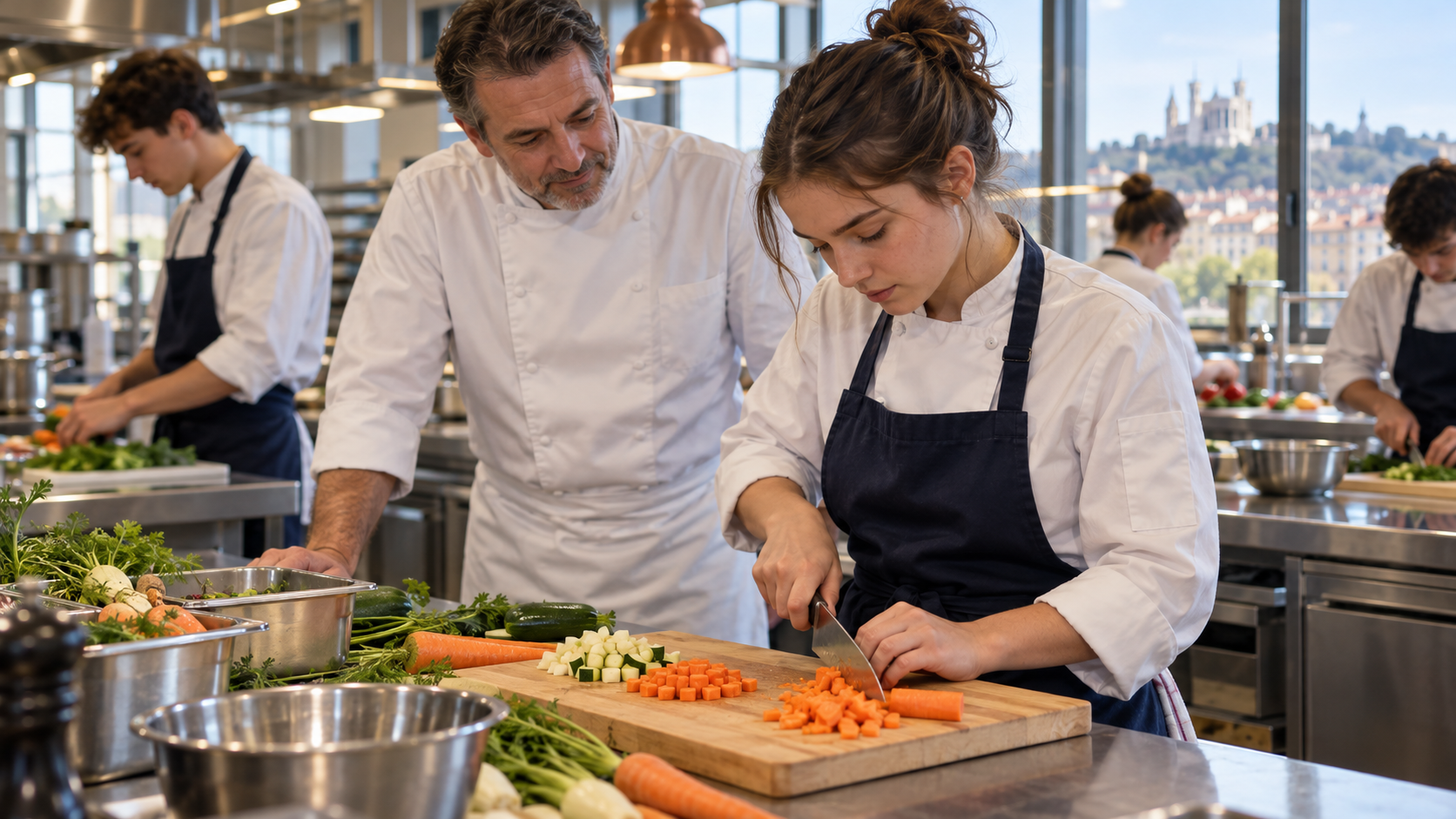
The Chef Did It in Thirty Seconds. You're Still Struggling After Ten Minutes.
The kitchen is almost silent.
You hear knives against cutting boards, running water, and pans moving across workstations.
In front of you, the instructor has just finished a demonstration.
The technique looked simple.
Precise.
Effortless.
They explained everything.
How to hold the tool.
Where to place your fingers.
How to achieve a consistent result.
You watched carefully.
You even thought:
"Okay, I understand."
Then the instructor said:
"Your turn."
And suddenly, everything felt different.
Your movements are uncertain.
You struggle to find the right position.
You start again.
You glance at your classmates.
Some already seem to be making progress.
And an uncomfortable thought appears:
"Why does this look so easy for everyone else?"
Watching a technique isn't the same as performing it
When you observe an experienced professional, you're watching the result of hundreds, sometimes thousands, of repetitions.
Their movements have become precise.
They recognize positioning errors almost immediately.
They make small adjustments without consciously thinking through every step.
But you're still learning.
You have to think about your hand position.
The sequence of movements.
The amount of pressure.
Safety requirements.
The expected result.
All at once.
It's understandable that your first attempt won't be as smooth.
What has become automatic for an experienced professional still requires considerable attention from a beginner.
Being watched can make things harder
Imagine Emma, a culinary apprentice.
During a practical lesson, she has to produce evenly cut pieces.
She knows the instructions.
She's watched the demonstration.
But when the instructor approaches her workstation, she becomes tense.
She wants to perform well.
So she hesitates.
Her cuts become less consistent.
Immediately, she thinks:
"Maybe I'm not suited to this profession."
But she's simply encountered a technical difficulty.
One she can work on.
The real problem begins when she turns one imperfect movement into a judgment about her professional potential.
Break the technique down before trying to work faster
When learning a new practical skill, don't immediately try to match your instructor's speed.
Start by identifying the important steps.
1. Observe the essentials.
Which movements matter?
What position should you adopt?
What mistakes should you avoid?
2. Practise slowly.
Prioritize accuracy and safety.
Speed can develop through practice.
3. Ask for specific feedback.
Instead of simply asking:
"Is this okay?"
Try:
"What should I change about my hand position?"
A precise question often leads to more useful feedback.
4. Improve one element at a time.
Don't try to perfect everything simultaneously.
Focus on the part causing the greatest difficulty.
One unsuccessful attempt doesn't define your future
Practical skills take time to develop.
You can understand an instruction today and still need repeated practice to perform it confidently.
That doesn't mean you lack ability.
It means you're learning.
The important question isn't whether your first attempt looks like the chef's.
It's what you can improve next time.
Prepare the theory to make practical learning easier
With Glamzn's Chat with Course, you can revisit your training materials and clarify the theoretical steps behind a technique.
Flashcards can also help you remember professional vocabulary, procedures, and safety rules.
These tools don't replace demonstrations or instructor supervision. Some techniques must always be learned and practised under professional guidance.
Next time a technique feels difficult, don't immediately question whether you belong in the profession.
Ask yourself:
"Which part of this movement do I still need to learn?"
Because you don't need the hands of an experienced professional on your first day. You're there to develop them.