




Data-Driven Authentication: How Multispectral Imaging Reclassified a Titian Masterpiece
The Shift from Subjective Expertise to Optical Certainty
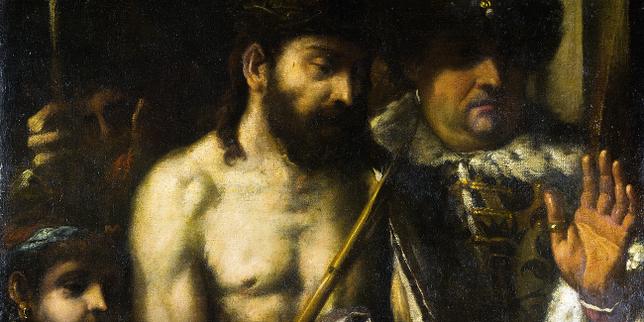
For centuries, art authentication relied on the connoisseur’s eye—a subjective metric that frequently resulted in misattributions and market volatility. The recent reclassification of an Ecce Homo painting, currently on display at the Musée Condé in Chantilly, marks a transition toward empirical verification. Originally categorized as a product of Titian’s workshop, the piece has been elevated to an autograph work by the Venetian master himself following rigorous technological scrutiny.
The valuation gap between a workshop piece and a confirmed autograph work by a master like Titian can exceed 1,000%. In this instance, the evidence did not come from a stylistic debate but from the underlying layers of the canvas. By utilizing multispectral imaging and X-ray fluorescence, researchers bypassed the surface pigments to analyze the initial compositional stages, revealing a logic of execution unique to the artist.
- Multispectral analysis identified pentimenti—changes of heart—that suggest an original creative process rather than a copyist's mimicry.
- Pigment mapping confirmed the use of high-grade lapis lazuli and specific lead-tin yellows consistent with Titian’s personal inventory.
- Underdrawing comparisons showed a confident, rapid brushwork style that aligns with Titian's late-period technical signature.
The Economics of Attribution in the Modern Art Market
This reattribution changes the asset's standing within the private collection of its Cypriot owner and the broader academic record. When a work is downgraded to 'Studio of,' its liquidity vanishes; conversely, a confirmed attribution creates a unique market event. The Musée Condé exhibition serves as a public audit of these findings, allowing the scientific data to be viewed alongside the physical object.
Modern authentication now functions like forensic accounting. Analysts look for specific anomalies in the 'data' of the paint layers that contradict a 16th-century origin or suggest the mechanical hand of an apprentice. In the case of the Chantilly Ecce Homo, the lack of a rigid under-grid suggested the artist was composing directly on the canvas, a hallmark of Titian’s mature method that apprentices were rarely permitted to attempt.
Technical Infrastructure Behind the Discovery
The hardware used in these investigations has seen a 40% reduction in size and a massive increase in resolution over the last decade. Portable X-ray fluorescence (pXRF) units now allow for high-resolution elemental analysis without moving the artwork from its climate-controlled environment. This minimizes risk while maximizing the data points available for comparison against known databases of Titian’s chemical signatures.
- Non-invasive scanning ensures the physical integrity of the 500-year-old fibers.
- Digital layering allows historians to toggle between the visible light spectrum and infrared views.
- Cross-referencing with the Prado and Louvre databases provides a statistically significant baseline for comparison.
By 2027, the integration of machine learning algorithms trained on verified brushstroke patterns will likely become the standard for preliminary authentication. This shift will force a massive re-evaluation of museum inventories worldwide, potentially devaluing thousands of 'circle of' attributions while surfacing rare, misidentified gems. The success of the Chantilly exhibition proves that the market is ready to trade subjective opinion for verifiable spectral data.

AI Video Creator — Veo 3, Sora, Kling, Runway